The Quivering of the Reed at Imitación a la vida, Montevideo Uruguay
June 11, 2026
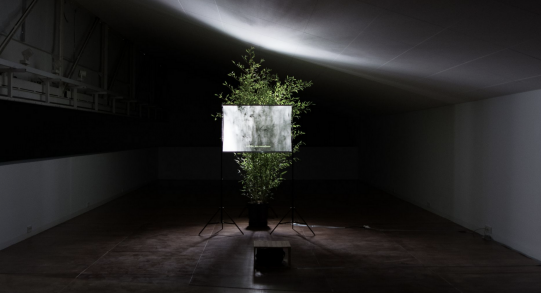
The Quivering of the Reed (2019) is now on view as part of Imitación a la vida, a group exhibition curated by Mario Gutiérrez Cru at the Centro Cultural de España in Montevideo and organised in collaboration with PROYECTOR. Plataforma de Imagen en Movimiento.
Bringing together works by Juan Carlos Bracho, Abelardo Gil-Fournier, Lois Patiño, Eugenio Ampudia, Enar de Dios Rodríguez and Bárbara Fluxá, the exhibition explores the unstable boundaries between nature and its representation: between living environments and the images, technologies and gestures through which we attempt to register, reproduce or recreate them.
The Quivering of the Reed brings these questions into a continuously unfolding image. A rotating tree stands between a powerful light source and a suspended translucent paper screen, where its leaves generate a film in real time through shifting shadows, light and blur. Bringing together vegetal life and the mechanisms of the moving image, the installation asks whether images reproduce the temporal processes of the living world—or whether the time of images itself has begun to transform the world around us.
La vibración de los juncos (2019) forma parte de Imitación a la vida, exposición colectiva comisariada por Mario Gutiérrez Cru en el Centro Cultural de España en Montevideo y organizada en colaboración con PROYECTOR. Plataforma de Imagen en Movimiento.
La exposición reúne obras de Juan Carlos Bracho, Abelardo Gil-Fournier, Lois Patiño, Eugenio Ampudia, Enar de Dios Rodríguez y Bárbara Fluxá para explorar los límites inestables entre la naturaleza y su representación: entre los entornos vivos y las imágenes, tecnologías y gestos con los que tratamos de registrarlos, reproducirlos o recrearlos.
La vibración de los juncos traslada estas cuestiones a una imagen en permanente formación. Un árbol en rotación se sitúa entre una potente fuente de luz y una pantalla suspendida de papel translúcido, sobre la que sus hojas generan una película en tiempo real a través de sombras, luces y desenfoques cambiantes. Al poner en relación la vida vegetal con los mecanismos de la imagen en movimiento, la instalación plantea si las imágenes reproducen los procesos temporales del mundo vivo o si, por el contrario, es el propio tiempo de las imágenes el que ha comenzado a transformar el mundo que nos rodea.