Opening: Icarus and the Turing Horse
December 04, 2025
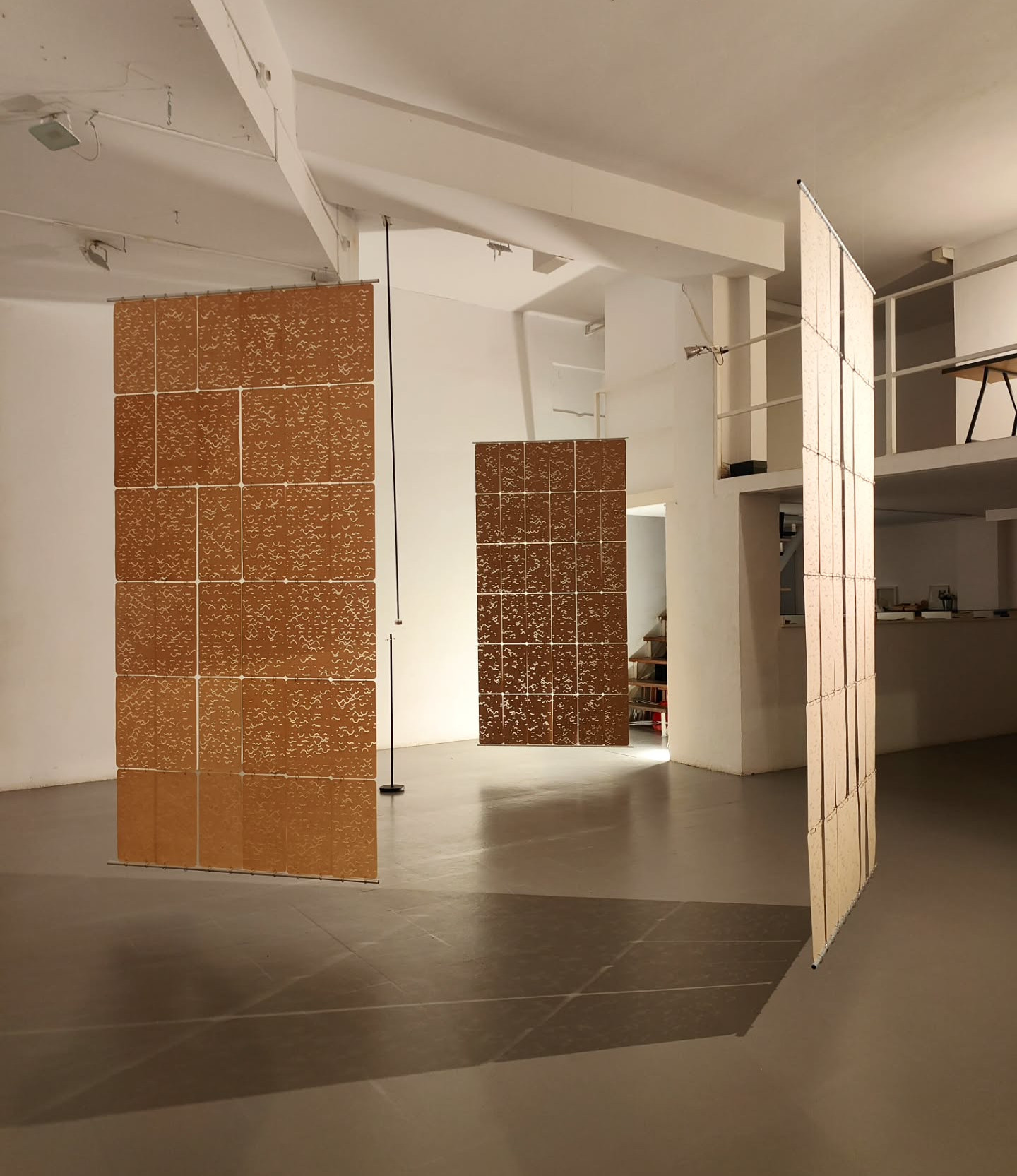
Icarus and the Turing Horse is the result of encountering a misprint: the typographical error that turned the horse of Turin, the wounded and weary animal that Nietzsche embraced in an extreme gesture, into ‘the Turing horse’. This short-circuit slips in a genealogy between the animal and the computational, where a universal model of patterns proposed by Turing to explain zebra stripes is intertwined with initiatives such as the mass bird ringing pursued by the ICARUS project (International Cooperation for Animal Research Using Space). Where computation displays its plasticity, what emerges is not simply a predictive machine, but a device that reinscribes bodies, environments and signals in a material alphabet with no ground.
The exhibition, Icarus and the Turing Horse, presents an installation consisting of large panels of punch cards that transcribe, using a ringing standard converted into typography, ancient texts of omens based on ornithomancy. It is accompanied by a series of slides with iconic images from art history intervened with automatic patterns. To think from the misprint—the Turing horse—is to think again about that embrace: a gesture that unites the wounded animal, the abstract machine, and human fragility under the British mathematician’s still-open question: ‘The stripes are easy, but what about the rest of the horse?’
CRUCE, C/ Dr. Fourquet 5 Madrid From 5/12-10/01 Opening 4/12, 19:30
Icarus y el caballo de Turing nace de una errata: el accidente tipográfico que convierte al caballo de Turín, el animal herido y cansado al que Nietzsche abrazó en un gesto límite, en el “caballo de Turing”. Ese cortocircuito permite adivinar una genealogía entre lo animal y lo computacional, donde un modelo universal de patrones propuesto por Turing para explicar las rayas de las cebras se entrelaza con iniciativas como el anillado masivo de aves perseguido por el proyecto ICARUS (International Cooperation for Animal Research Using Space). Allí donde la computación despliega su plasticidad, lo que emerge no es simplemente una máquina predictiva, sino un dispositivo que reinscribe cuerpos, entornos y señales en un alfabeto material sin suelo.
En CRUCE, Icarus y el caballo de Turing se presenta como una instalación formada por grandes paneles de tarjetas perforadas que transcriben, mediante un estándar de anillamiento convertido en tipografía, antiguos textos de presagios basados en la ornitomancia. Le acompaña una serie de diapositivas con imágenes icónicas de la historia del arte intervenidas con patrones automáticos. Pensar desde la errata -el caballo de Turing- es pensar de nuevo en aquel abrazo: un gesto que une al animal herido, la máquina abstracta y la fragilidad humana bajo la pregunta, todavía abierta, del matemático británico: “las rayas son fáciles, ¿pero qué ocurre con el resto del caballo?”.